Where is the nest?
The nest location matters. Stinging insects can establish nests in the ground, under eaves, inside wall voids, around decks and sheds, or high in trees and shrubs.
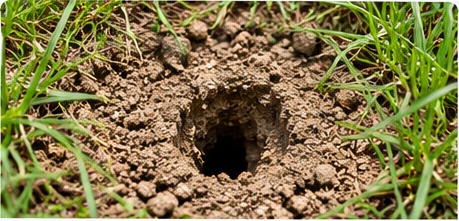
In the ground
Yellow jackets often use underground cavities. Lawn mowing, trimming and foot traffic can disturb an active nest.
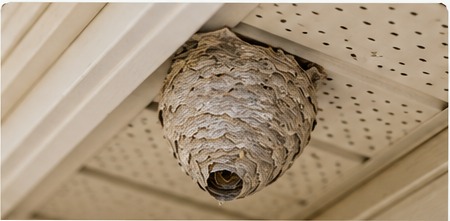
Soffits, siding & walls
Repeated insect traffic through one opening can indicate a nest in a structural void. Avoid sealing an active entry before the nest is addressed.
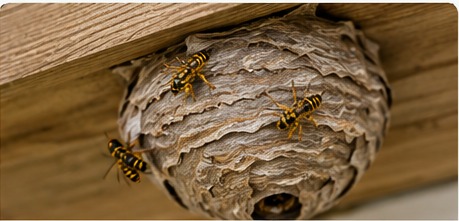
Eaves, decks & sheds
Paper wasps commonly build exposed comb nests in protected locations around structures.
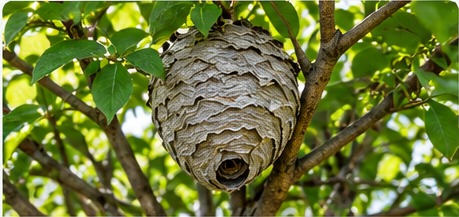
Trees & shrubs
Large enclosed paper nests may be built above ground in landscaping, trees or other protected areas.
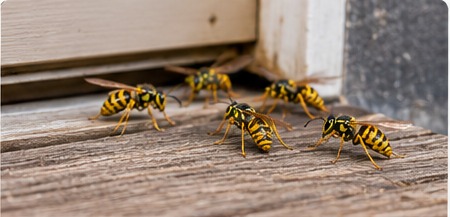
Doorways & patios
Nests near frequently used entrances and outdoor living spaces can create an immediate concern for people and pets.
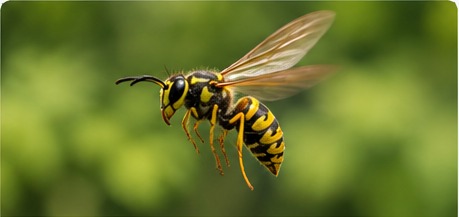
Can't find it?
Watch from a safe distance for repeated flight to and from the same location. You do not need to approach the nest to request service.
What are you seeing?
These quick clues can help describe the problem when you call. Exact identification can be confirmed during service when needed.
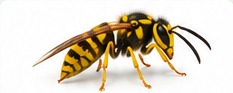
Yellow Jackets
Compact yellow-and-black wasps. Often associated with ground nests or concealed structural cavities.
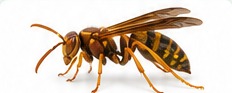
Paper Wasps
Slender wasps with long legs. Commonly associated with open-comb nests under eaves and other protected surfaces.
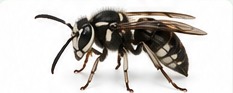
Bald-Faced Hornets
Black-and-white social wasps that can build large enclosed paper nests in trees, shrubs and on structures.
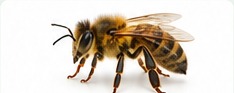
Bees
Bees can be mistaken for wasps. If you are unsure what you have, describe the insects and nest location before treatment is selected.
Have an active nest? Avoid these common mistakes
- Do not plug or seal an active wall, siding or soffit entrance before the nest is addressed.
- Do not strike, knock down or closely approach an occupied nest.
- Avoid mowing or trimming directly over a suspected ground nest.
- Keep children and pets away from the active area.
- If using any pesticide yourself, read and follow the product label exactly.
How professional wasp treatment works
Locate & identify
The insect activity and nest location are evaluated so the treatment can match the situation.
Treat the active nest
The appropriate treatment is directed at the nest or active entry point, with attention to the structure and surrounding area.
Next-step guidance
You receive guidance about the treated area, nest removal when appropriate, and what activity to watch for afterward.
Wasp & hornet questions
Do you treat active nests?
Yes. Treatment options are available for active wasp, yellow jacket and hornet nests.
Do you treat yellow jackets in the ground?
Yes. Ground-nesting yellow jackets are a common stinging-insect problem during the warmer months.
What if they are going into my siding?
Repeated traffic through the same opening can indicate activity in a wall or structural void. Avoid sealing the opening before the active nest is addressed.
Can nests under decks or near doors be treated?
Yes. When you request service, describe the location and whether the nest itself is visible.
Do you handle bald-faced hornet nests?
Service can be requested for aerial hornet nests in trees, shrubs and around structures.
How quickly can service be scheduled?
Call 586-684-1071 for current availability. Urgent situations are prioritized when scheduling allows.
Wasp & Hornet Service in Oakland & Macomb Counties
Service is available in Rochester Hills, Troy, Auburn Hills, Pontiac, Lake Orion, Shelby Township, Sterling Heights, Washington Township and surrounding Oakland and Macomb County communities. Call 586-684-1071 to confirm service availability for your address.
Service is provided by a Michigan-licensed pest-control company.